East-West Bowl All Name Candidate

Follow along with the video below to see how to install our site as a web app on your home screen.
Note: This feature may not be available in some browsers.
East-West Bowl All Name Candidate

Precisely - it's not. It would give Desmond a better argument if he was like a lot a people who are forced to sign things just to get a job. His case is weaker because this was a struck bargain.But is this an employee/employer situation ?
I doubt they do, honestly.The Big 10’s counsel obviously feels differently.
I’m not sure. There is a ton of case law I could point to where courts don’t like to enforce liquidated damages provisions.Precisely - it's not. It would give Desmond a better argument if he was like a lot a people who are forced to sign things just to get a job. His case is weaker because this was a struck bargain.

The only real solution to this is to make the players employees but the schools and NCAA don’t what that.I doubt they do, honestly.
This is like a classic 1L Contracts hypo situation here. I’m not saying anything that ground breaking. The liquidated damages are really not close to whatever economic damages Washington would have from a breach IMO, which is the major threshold for enforceability. And I doubt that the B1G would want to go to court and find out (think about the follow on effects for every other NIL/rev share agreement if the case goes against Washington).
This is all basically just a starting point for negotiations on a settlement.
Collective bargaining is the only real solution IMO, but that would require the schools to give up more control.The only real solution to this is to make the players employees but the schools and NCAA don’t what that.

you don't think his agent reviewed and commented on the agreement? There is likely a good argument it was bargained for given that the rumor is Desmond would have been one of the 2-3 highest paid guys in college football when he signed (i.e., he was willing to make departure onerous to get the payday).
Collective bargaining is the only real solution IMO, but that would require the schools to give up more control.
I'm guessing this has an arbitration clause. Not sure how that would be set up.I’m not sure. There is a ton of case law I could point to where courts don’t like to enforce liquidated damages provisions.
we don't know if this is a NIL agreement. It is with the school, and we can't see the definition of consideration that applies to this agreement.NIL agreements can’t functionally bind athletes to schools at the moment. The buyout being at the sole discretion of the university will not stand. Attempting to restrict movement brings into question anti-trust liabilities. Attempting to bind labor to one institution I believe will also bring into question restraint of trade.
Truth be told, until there is an anti-trust granted to the NCAA and a players union I really don’t know that NIL agreements mean anythinf other than they agree to pay an athlete X dollars
Strong agree. Washington would be entitled to recoup whatever money they’ve actually paid him under the contract, and I think that’s a fair result, but anything else would get thrown in the trash.NIL agreements can’t functionally bind athletes to schools at the moment. The buyout being at the sole discretion of the university will not stand. Attempting to restrict movement brings into question anti-trust liabilities. Attempting to bind labor to one institution I believe will also bring into question restraint of trade.
Truth be told, until there is an anti-trust granted to the NCAA and a players union I really don’t know that NIL agreements mean anythinf other than they agree to pay an athlete X dollars
Maybe but the arbitrator is still bound by whatever the law says.I'm guessing this has an arbitration clause. Not sure how that would be set up.

Feldman said on the Audible that he understood the agent wasn’t involved in the decision to transfer - I think he said a family member instigated it.So I wonder then if this a CYA or is he implying that Demond did this all behind his back without his knowledge? Both scenarios are definitely Bravo worthy.
This is also an example of why the sports agency industry is so fucked up. This guy representing both a player and coach on the same team is clearly conflicted. There are serious questions in my mind as to whether he had the player’s best interests in mind.Feldman said on the Audible that he understood the agent wasn’t involved in the decision to transfer - I think he said a family member instigated it.
No way this guy would burn Jedd Fisch. Fisch is going to make a fortune on his next deal.
Man, what a mess. He could see a breach of fiduciary duty lawsuit at some point.This is also an example of why the sports agency industry is so fucked up. This guy representing both a player and coach on the same team is clearly conflicted. There are serious questions in my mind as to whether he had the player’s best interests in mind.


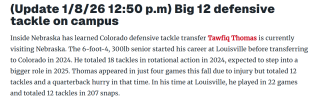
I'm guessing it this dude -
Tawfiq Thomas - Football - University of Colorado Athletics
Tawfiq Thomas (95) Defensive Tackle - AT COLORADO 2025 (Sr.) Played in four games during the 2025 season. Missed the other eight games due to injury. Finishe...cubuffs.com
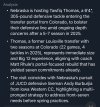

I'm guessing it this dude -
Tawfiq Thomas - Football - University of Colorado Athletics
Tawfiq Thomas (95) Defensive Tackle - AT COLORADO 2025 (Sr.) Played in four games during the 2025 season. Missed the other eight games due to injury. Finishe...